

Urban greenspaces
by Philip Dundas
My eyes were fields before the navvies came to carve me up.
Two drinking bowls, fed by a chalky stream, cups to quench a city’s thirst.
Abandoned then, a down-and-out, a road-crashed dosser, I had no friend to drink with me.
No fish in my poisoned gut and no birds on my sagging flanks.
Now, years on, a brash new crew, living in their towers of glistening glass,
Have come to wake me from old soakdom.
Heron and vole hide in my stubble; at dusk bat and swift skim my shimmering skin.
The waters live again, where my eyes were.
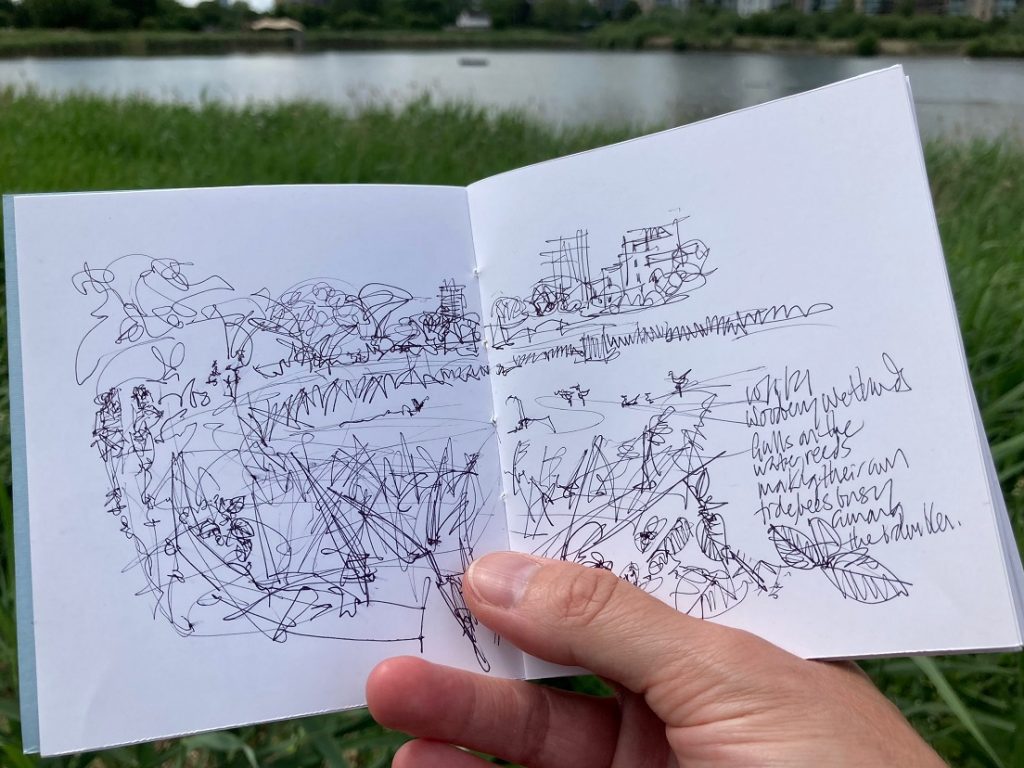
I was brought up on a farm in Scotland. The open fields were sewn into my being. Objects and places from that time start to form upon my conscious mind. Memories have always been triggered for me by passing details, small things that form and reform in particular ways. The grass, rock, water, wind, moss and earth that make up our physical contact with the environment. A path through a field, baler’s twine caught on a fence post, a swallow’s nest under the eaves of a pantile roof, lichen on the wall of a sandstone byre, the carapace of a caddis fly ebbing in the flow of a stream. They accrete, creating an internal map, a set of infinitesimal dots connecting neurons, forming pictures in the mind. Images that remain. My mind attached to things it could clearly see, tangible things became symbols of safety and certainty, places of refuge. I had no capacity for storing lost connections, unhappy stories. The relationships I had so far been offered were risky and unpredictable, so my preference was for a colloquy with my surroundings. Place is rich with sensation.
Half a century later, having lived in this city most of my adult life, I moved here, to Woodberry Down. It is a new city development, a collection of towers overlooking one of London’s historic sources of drinking water. The New River was originally dug out to bring the city fresh water from Hertfordshire. Two hundred years later, a brace of reservoirs were constructed here to slake London’s thirst. They were abandoned after the war: one then became a sailing lake and the other, more recently, a wildlife reserve. From where I live, you can see these two watering holes, complete with their pumping stations, adapted today for modern life. One alive with swimmers and sailors, the other bound by thick reed beds, a sanctuary for wildfowl. I walk the paths, observing the plants and the trees, listening to the birdsong cut through the early morning air and the bats throwing their sonar across the evening sky. And something still of that boyhood remains, the need to map my life against the details of what surrounds me. I swim in the reservoir and have the feeling that the place is alive. Though it has lain fallow, unnoticed for decades, the life of it has always been here. Place is rich with sensation.
And Philip’s centena and essay are also “rich with sensation.” I love how he embodies the urban green space of his centena and then moves into a more reflective piece in his essay, showing us the details of that farmland in Scotland is relatable to anyone (me) who grew up in the countryside but have settled in urban areas – you simply cannot get the country out of you! Those ‘watering holes’ are real jewels in the city.